A browser wallet can make a transaction easier to sign, but it cannot make a risky transaction safe. That is the counterintuitive starting point for anyone considering a Rabby extension download. In decentralized finance, the largest danger is often not losing access to a wallet; it is approving an action whose consequences were misunderstood. A multi-chain wallet therefore has two jobs: manage keys and improve the user’s ability to interpret on-chain activity. Rabby is positioned around Ethereum and EVM-compatible networks, and its value is best assessed through that mechanism—not through the broad claim that one wallet can eliminate DeFi risk.
For US users moving among decentralized exchanges, lending markets, bridges, and token applications, the practical question is not simply whether Rabby Wallet supports multiple networks. It is whether the extension helps the user distinguish a routine transaction from an authorization that could expose assets later. That distinction matters because a transaction can be validly signed, successfully confirmed, and still be economically harmful. Wallet software sits at the boundary between human intent and smart-contract execution, but it does not control the contracts themselves.
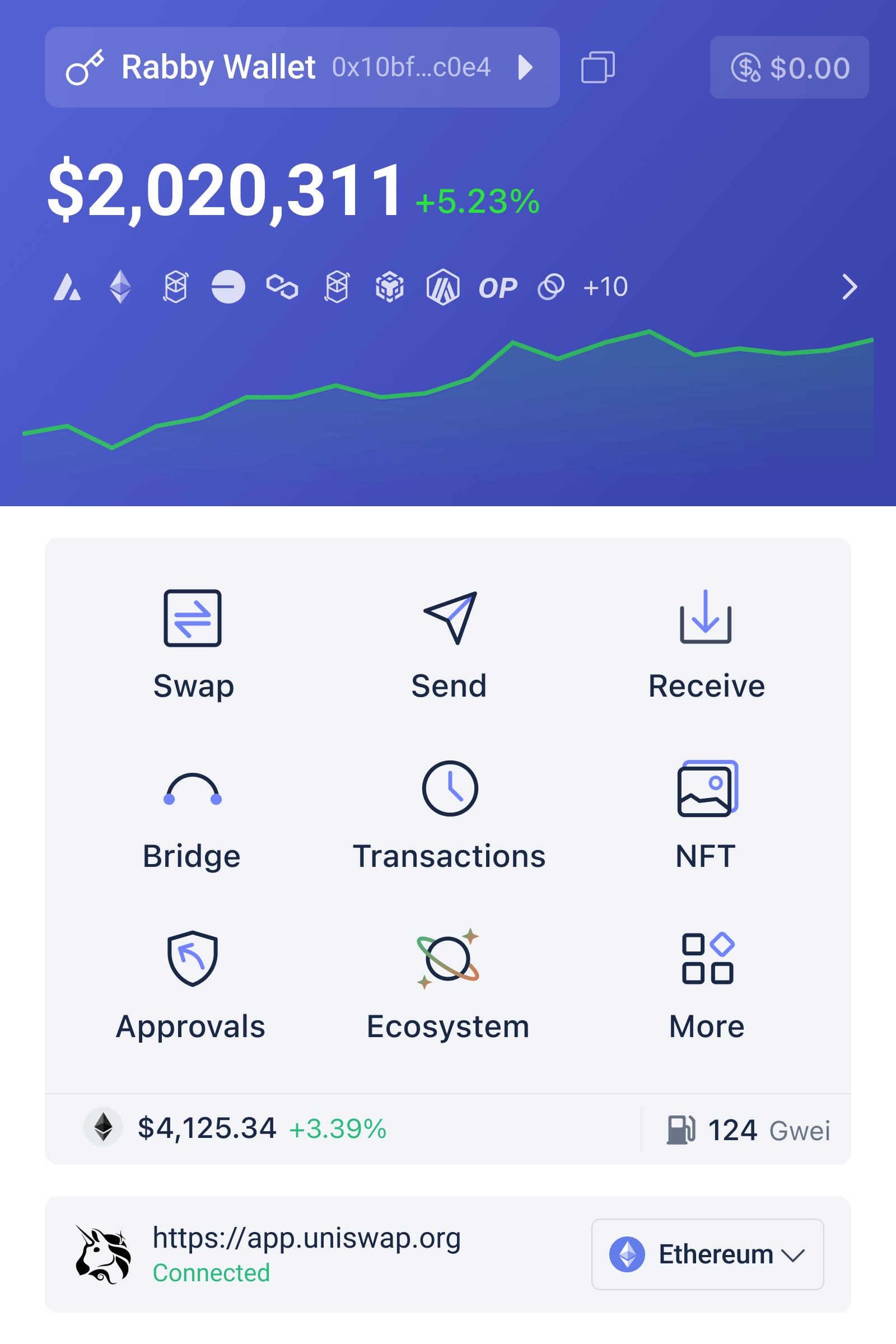
Myth One: A Multi-Chain Wallet Means One Account Works Everywhere
The phrase “multi-chain wallet” is easy to misread. It does not mean that Ethereum, Arbitrum, Optimism, Polygon, and other EVM networks share one ledger. Each network maintains its own state, fees, contract deployments, and transaction history. An EVM, or Ethereum Virtual Machine, is the common execution environment that allows related networks to use similar address formats and smart-contract conventions. Similarity improves portability, but it does not erase chain-specific differences.
Rabby’s multi-chain design can make network selection and account management more convenient, particularly for users who interact with several EVM applications. Yet the same convenience creates a boundary condition: an address that looks familiar may exist on many networks while holding different assets on each one. A token balance on one chain does not automatically become a balance on another. A bridge transaction may create a representation of an asset elsewhere, while a swap may depend on liquidity that exists only on the selected network.
This is why a careful installation and first-use process should include more than creating or importing an account. Check the network displayed in the wallet, confirm that the application is connected to the intended chain, and treat unfamiliar network prompts as a reason to pause. The extension can organize a multi-chain environment; it cannot infer every economic intention behind a user’s click.
Myth Two: Transaction Simulation Is the Same as a Security Guarantee
One of the more useful ideas in modern wallet design is transaction simulation. Before signing, software may attempt to show expected balance changes, contract interactions, or the assets that could be received and spent. This gives the user a more informative preview than a raw hexadecimal transaction. For DeFi users, that preview can reveal an unexpected token transfer, a suspicious approval, or a mismatch between the advertised action and the likely result.
But simulation is an analysis of a proposed state change, not a guarantee of future safety. The result depends on the application’s transaction data, the current state of the network, the behavior of the contracts involved, and the quality of the wallet’s interpretation. A contract can also contain permissions or upgrade mechanisms whose consequences are not obvious from a single transaction. If market conditions change between review and execution, the economic outcome may differ even when the transaction behaves as expected technically.
The sharper mental model is this: wallet warnings reduce information asymmetry, but they do not transfer responsibility for the decision from the user to the wallet. A warning-free screen should be treated as evidence that no known problem was detected, not proof that the opportunity is legitimate or profitable. Conversely, a warning is a prompt for investigation, not automatically proof of malicious behavior. Context remains essential.
Myth Three: Installing the Extension Is a Minor Technical Step
For a self-custody wallet, installation is part of the security model. The browser extension has access to the wallet interface and may mediate requests from decentralized applications. If a user installs a counterfeit package, shares a recovery phrase, or imports keys into an untrusted environment, later transaction reviews cannot repair the initial compromise. The most important protection is therefore procedural: obtain the software through a trusted official distribution path, inspect the publisher and permissions, and avoid links delivered through unsolicited messages or urgent “support” requests.
Readers seeking the correct starting point can review the rabby extension download information before installing. The link should be treated as a navigation aid, not as a substitute for verification. Confirm that the browser, extension identity, and installation flow match the wallet’s official presentation. Never enter a recovery phrase into a webpage claiming to “activate,” “sync,” or “verify” an existing wallet.
After installation, a sensible sequence is deliberately uneventful. Create a new wallet only when the device and browser environment are trusted. Record the recovery phrase offline and protect it from cameras, cloud notes, email, and shared storage. If importing an existing wallet, understand that the security of the new environment becomes relevant immediately. A hardware wallet can reduce exposure of private keys during signing, but it does not make a deceptive transaction harmless; the user still has to review what is being approved.
Myth Four: A Wallet Protects the Investment
A cryptocurrency wallet controls credentials and helps authorize transactions. It does not insure token value, validate a protocol’s business model, guarantee liquidity, or reverse an irreversible transfer. This distinction is especially important in DeFi, where a wallet may connect a user to experimental contracts, thin markets, governance systems, and applications whose risks are not visible in the wallet’s interface.
Consider a token approval. The user may think they are swapping an asset, while the transaction also grants a contract permission to spend tokens in the future. The approval can be operationally normal and still create a longer-lived exposure than the immediate swap. Reviewing allowances, using appropriate limits where available, and periodically removing permissions can reduce that exposure, although allowance management itself involves transactions and network fees.
There is a similar distinction between custody risk and protocol risk. Keeping keys secure addresses one category of failure. It does not address an oracle error, a flawed liquidation mechanism, a bridge failure, a compromised application, or a market that cannot absorb a sale at the displayed price. A multi-chain wallet can make access to these systems more efficient, which is useful, but efficiency can also increase the speed at which a mistake propagates across networks.
A Practical Decision Framework for Rabby Users
Before approving a DeFi transaction, separate four questions that are often collapsed into one. First, is this the intended application and network? Second, does the wallet preview describe the expected assets and permissions? Third, what authority will the contract retain after the transaction? Fourth, what happens if the market moves, the transaction fails, or the application behaves differently later?
This framework is more reliable than relying on a single security label. It also helps explain why a browser wallet may be particularly useful for experienced users without being risk-free for beginners. The interface can expose more context, but additional information only helps when the user knows which differences matter. A person who cannot explain why a contract needs token approval should not approve it merely because the application is familiar.
Network fees deserve similar attention. EVM chains may use different fee markets and may require the user to hold the network’s native asset for transaction costs. A transfer that appears inexpensive on one chain may be impractical on another, while bridging introduces separate operational and smart-contract risks. In the United States, users should also keep records of transactions for tax reporting and portfolio accounting; a wallet view is useful evidence of activity, but it is not necessarily a complete tax determination.
What to Watch as Wallets Become More Interpretive
Recent Rabby messaging dated August 24, 2026 emphasizes Ethereum and EVM support, a simple and fast experience, and availability across Chrome and Brave. Those claims point to a broader direction in wallet design: wallets are becoming interpretation layers, not merely key-storage tools. If that direction continues, the most valuable improvements will be clearer permission explanations, better handling of cross-chain identity, and more transparent communication of uncertainty when a simulation cannot confidently describe a contract.
The constraint is that interpretation remains difficult when applications are composable and state changes rapidly. A wallet may explain the immediate call while the deeper economic risk lies in a protocol dependency, an upgrade authority, or a liquidity assumption. Therefore, users should welcome better warnings while continuing to inspect the application, contract context, and transaction purpose independently. The likely future benefit is not a risk-free DeFi experience; it is a smaller gap between what a transaction technically does and what a user thinks it does.
Frequently Asked Questions
Is Rabby Wallet suitable for every blockchain?
Rabby is designed around Ethereum and EVM-compatible networks. It should not be assumed to support every blockchain, particularly networks that use different execution environments or address systems. Check network compatibility before transferring assets or connecting an application.
Can Rabby recover funds sent to the wrong network?
Usually, a wallet cannot reverse a confirmed blockchain transaction. Recovery may sometimes be technically possible when the same private key controls the destination address on another compatible network, but the result depends on the asset, network, wallet access, and contract behavior. It is safer to verify the network and receiving address before signing.
Does a wallet warning mean a transaction is definitely a scam?
No. A warning indicates that the wallet has identified a potential concern or an interaction that deserves review. It is a signal to investigate the contract, permissions, network, and expected outcome. Likewise, the absence of a warning does not certify a protocol or investment.
The strongest reason to use a multi-chain wallet is not that it removes complexity. It is that, when properly designed and carefully used, it can make some of that complexity visible before a signature is made. Rabby’s browser extension may improve the review process for EVM-based DeFi, but the central security habit remains unchanged: verify the network, understand the permission, question the promised outcome, and sign only when the transaction matches your actual intent.